
Orange News: As the world struggles to meet the Paris Agreement targets, it is time to adopt a ‘Radical Realism’: accepting and preparing for global warming far beyond the 1.5 ℃ — or even 2 ℃ — threshold. Current projections indicate a likely temperature rise of 3.1℃ by 2100, with the 1.5℃ limit potentially exceeded as early as 2029. With nationally determined contributions falling short — and the United States, the world’s largest economy, having previously withdrawn from the Paris Agreement — climate overshoot is no longer a future scenario but an unfolding reality.
Rising temperatures, accelerating biodiversity collapse, and more extreme weather events are not hypothetical; they are happening now. Biodiversity loss, in particular, constitutes a climate risk multiplier. Against this backdrop, adaptation and resilience must urgently rise alongside mitigation. As economies falter and budgets tighten, the question becomes: how can governments make public spending go further while building long-term resilience?
One answer lies in nature-based solutions (NbS) — actions that work with nature to maintain and restore ecosystems while meeting human needs for climate adaption and risk reduction. From cooling urban areas with green infrastructure, to the use of traditional gei wai shrimp ponds as flood buffers, NbS protect biodiversity, enhance liveability, and offer cost-effective, multifunctional solutions. Our failure to properly value ecosystems — economically and in planning decisions —has led to missed opportunities. When nature is undervalued, we not only degrade the environment but lose critical defences against climate impacts.
China has recognised the growing threat of climate change and biodiversity risk. Its updated National Biodiversity Strategy and Action Plan marks a significant shift — embedding biodiversity protection and environmental goals into national development frameworks and urban planning.
In this context, the Greater Bay Area (GBA), home to major cities like Hong Kong and Shenzhen, and rich in ecological assets, has been identified as a key strategic area. Rather than a trade-off between economic growth and nature, the vision is to make the GBA a green innovation corridor where nature enhances cities’ resilience and competitiveness.
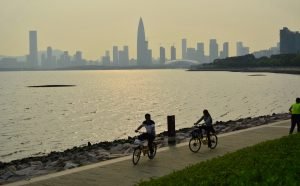
At the centre of this transition zone lies Hong Kong’s Northern Metropolis — a 30,000-hectare urban development project along Shenzhen Bay poised to reshape the city’s northern edge and strengthen cross-border connectivity. Home to unique ecosystems but also highly exposed to climate risks like extreme heat, hill fires, flooding, sea-level rise, and landslides, threat and opportunity are closely allied: With early integration of NbS, the Northern Metropolis can become a showcase for climate-smart, biodiversity-sensitive urban development where prosperity and ecological protection go hand in hand.
However, integrating NbS into urban development requires more than good intentions. Traditional planning models — segregating green, residential, and economic zones — have sidelined nature as a luxury rather than essential infrastructure. Radical realism demands a new planning paradigm, one that recognises and aligns biodiversity and nature’s capacities with transport, housing, and water management strategies.
NbS are not just trees or parks: They are holistic systems that cool cities, absorb floodwater, improve air quality, enhance wellbeing, and support biodiversity all at once. Especially in a climate-vulnerable city like Hong Kong, scaling up NbS and making them standard practice is essential.
What we need is a multilevel landscape network approach — one that emphasizes the importance of connecting fragmented ecosystems and transforming them into a cohesive, scalable network of NbS landscapes capable of delivering meaningful ecological and societal benefits. To make this work, coordinated efforts are needed across all levels — bringing together NbS specialists, private developers, financial strategists, philanthropies, NGOs, and governments to advance NbS.
With nature and biodiversity still economically undervalued, and the long-term benefits of biodiversity conservation slow to materialize, securing consistent, large-scale funding for NbS remains a significant challenge. To bridge this gap, governments must create an enabling environment for investment — through clear policy signals, capacity building on ecosystem service valuation, and participation in innovative financing mechanisms such as blended finance and Public-Private-Philanthropy Partnerships (PPPPs).
In blended finance models, public or philanthropic capital can be used to de-risk investments and attract private funding. Under a PPPP model, governments provide strategic direction, prioritising NbS as core components of infrastructure, philanthropic capital supports early-stage pilots, and the private sector follows with scalable investment, while public agencies provide technical guidance and long-term stewardship. For the Northern Metropolis, this approach could unlock new investment streams, especially by developing climate infrastructure that reduces future climate risk.
NbS offer us a path forward that is grounded in radical realism and driven by practical optimism. If we embed nature into our cities, not as an afterthought but as a foundation, we can design futures that are safer, cooler, more liveable — and more resilient.
As climate risks intensify and economic uncertainty grows, now is the moment to think big — and act smart: The Northern Metropolis is more than a new town development; it is Hong Kong’s opportunity to lead in green growth and building climate proof city.
Originally published on Orange News on 25 Jun 2025. Written by Kitty Tam and Rebecca Süss.