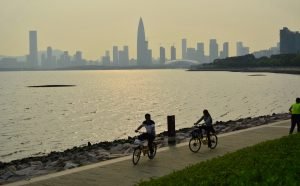

Orange News: As cities around the world grapple with rapid urbanisation, Hong Kong’s approach to managing its green spaces deserves closer examination. Beijing, an ancient capital, is leading the trend by using trees to provide shade along its walkways and bike lanes. A recent personal experience exploring Beijing by shared bike proved this to be an effective heat mitigation method – the trees’ cooling effect turned what could have been an unpleasant trek into a comfortable journey.
This begs the question: are Hong Kong’s urban trees merely decorative, or are they a key feature that improves the city’s resilience and livability? Reports from Liber Research Community suggest that urban renewal projects in districts like Kowloon City and Prince Edward threaten the removal of parks and mature trees, which risks the loss of these districts’ unique character. Hong Kong’s green spaces have the potential to become a city-wide attraction, offering opportunities for recreation and community building. As the city continues to evolve, preserving and enhancing these public assets should be a top priority.
Urban trees are undeniably an aesthetic addition to Hong Kong. They add to each district’s unique character and draw visitors, much like how Japan’s cherry blossom festivals are observed. Residents and international visitors alike gather for “Hanami”, the Japanese custom of flower viewing, a practice which originated in urban areas. A similar example can be found in Guangzhou’s Yongqing Fang Alleyway urban renewal project. Through this project, the old town alleyways were carefully renovated to become a sustainably constructed, picturesque public shared space for visitors and inhabitants. In fact, Hong Kong itself has proof of concept for the “tree-conomy”. Hong Kong’s Drainage Services Department (DSD) has launched the Ng Tung River Beautification Project with an aim to improve the surrounding area and strengthen the link between Ng Tung River and nearby communities. Notably, the project has seen the planting of more than 18,000 plants on both sides of the river, which will attract tourists during the flowering season.
But beyond tourism, what do urban trees mean for Hong Kong?
Firstly, urban trees are essential to improving walkability and overall quality of life. Trees increase property values, reduce stress levels and improve physical health by encouraging outdoor activity. In a dense city like Hong Kong, where the impacts of climate change are increasingly taxing on the local community, the cooling effects of urban forests are critical.
The statistics are alarming; average temperatures in Hong Kong continue to rise, with 2024 being the hottest April on record in 140 years. This abnormal heat is exacerbated by the urban heat island effect, which is the phenomenon where urban areas experience higher temperatures due to the prevalence of heat-absorbing surfaces like concrete and asphalt, as well as reduced greenery. Yet the solution lies right before our eyes – or rather, overhead. Trees provide shade, reduce energy demands for cooling via evapotranspiration, filter particle pollutants, and improve public health by reducing rates of cardiac arrest and obesity. Urban green spaces have been found to cool city streets by 2-4ºF and can even reduce premature deaths by a third!
To safeguard Hong Kong’s livability and combat the escalating effects of climate change, the city must make a commitment to preserving and expanding its urban green spaces. Crucially, newly planted trees must be carefully selected with reference to ecological research, to ensure they are well-suited for the local biodiversity. Studies have shown that plants tend to have higher carbon sequestration abilities when grown in their native environment. This may require closer collaboration between developers and government agencies.
The time required for young trees to mature into impactful specimens also shows the need for farsighted planning. We need look no further than the Wan Chai promenade, where rows of newly planted trees will take years to reach their full potential in heat reduction and carbon sequestration. To maximize the impact of these investments, the Leisure and Cultural Services Department (LCSD) must collaborate with the Agriculture, Fisheries and Conservation Department (AFCD) to implement urban nature-based solutions that are both scientifically grounded and responsive to community needs.
For the expansion of Hong Kong’s urban green spaces, we can take inspiration from the Swire Island East 2 development, which has been fashioned into an urban green space. Designed by American landscape architect Kathryn Gustafson, and with input from ecologist Dr. Hau Chi Hang of the University of Hong Kong, more than 260 species of both native and exotic plants were incorporated into the development’s urban greenery. Among these plants are two Incense Trees (Aquilaria sinensis). Their cultivation in Taikoo Square helps to protect them from illegal logging while taking advantage of their many ecosystem services. By applying similar integrated approaches across the city, Hong Kong can cultivate urban green spaces that serve as a draw for visitors and an upgraded public space for residents.
The preservation and expansion of Hong Kong’s urban trees does not come without its challenges. Balancing development needs with environmental concerns is challenging, and the monetary costs of maintaining urban green spaces must also be considered. Poorly planned maintenance practices can even generate large carbon emissions. To ensure that maintenance practices do not offset the climate benefits, we should pay more attention to preserving the original landscape instead of aesthetics, and select ecologically suitable species and materials.
Additionally, urban trees may act as a net carbon source in their initial years of growth. This is because the carbon sequestration via photosynthesis of urban trees in their early years is not yet enough to offset the carbon emissions resulting from construction and maintenance. Although there are short-term drawbacks, evidence suggests that the benefits of urban trees far outweigh these in the long term. With thoughtful planning and management, the full benefits of urban green spaces in Hong Kong can be realised.
Preserving and growing Hong Kong’s urban forests must be a top priority for policymakers and the public. Hong Kong should capitalise on the potential of urban green spaces to become a central draw for both residents and international visitors, instead of removing parks and urban trees. A thoughtfully curated “tree walk” linking the city’s diverse neighborhoods and natural environments could attract nature-seeking tourists from the mainland and beyond, showcasing Hong Kong’s commitment to livability and sustainability. By working to protect and expand its urban green spaces, Hong Kong can become a thriving metropolis for generations to come.
Originally published on Orange News on 16 Aug 2024. Written by Selina Yeung and Lawrence Iu.