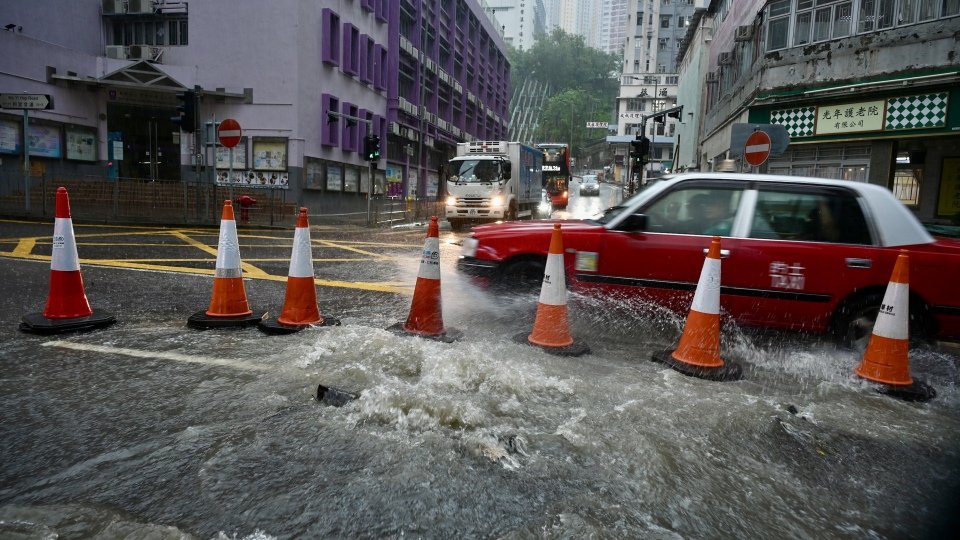
Orange News: When the Black Rain Fell on 4 August 2025, the heaviest August rain in Hong Kong’s history fell without mercy — 353 millimetres in a single day. Four black rainstorm warnings in just over a week. In Wong Tai Sin, staircases became white-water cascades. In Chai Wan, minibuses sat axle-deep in murky water. Basement shops in Tsuen Wan went dark. For a few tense hours, the city seemed to hold its breath.
And yet, it could have been much worse. Beneath our feet, the Government’s decades of quiet work — the Tai Hang Tung stormwater tank, the Lai Chi Kok drainage tunnel, pumping stations in West Kowloon, and river training in the northern New Territories — channelled millions of litres of water away from homes and businesses. Neighbourhoods that once flooded every summer stayed dry. Their foresight turned what could have been a crippling disaster into a disruption we could recover from within days.
That is the lesson the Chief Executive should carry into the upcoming Policy Address: in an era of climate volatility and geopolitical uncertainty, foresight is our strongest defence. The precautionary principle — acting before risks turn into crises — must run through Hong Kong’s economic strategy, not sit in the footnotes.
Learning from Our Defences
The black rain proved that preparing early works. If we took the Government’s approach and applied it across other sectors, we could protect not only our safety but also our long-term competitiveness.
Let’s start with people and nature. Imagine if every secondary school graduate understood how climate change will affect their own city — from typhoon intensities to biodiversity loss in Mai Po. If teachers had top-tier training and resources, and schools embedded climate and ecology into their development plans, Hong Kong would raise a generation ready to lead in the transition economy.
Our defences should also be living ones. Nature-based solutions — sponge-city designs in Kowloon East, oyster reef and mangrove restoration in Deep Bay, tree canopy layers along Nathan Road — could work alongside flood tunnels and tanks to absorb stormwater, cool streets, and bring biodiversity back into urban life. Tackling ozone pollution with the same determination, in partnership with Greater Bay Area cities, would mean clearer skies and healthier lungs on both sides of the boundary.
Powering the Transition Before the Clock Runs Out
Our electricity grid is the lifeblood of the economy, yet it still leans heavily on coal and gas. A precautionary approach means diversifying now — before climate risks or global market shocks force change on us.
One step: give Hong Kong’s financial sector the tools to lead. A transition finance taxonomy, aligned with Mainland China and the EU, would steer capital into genuine low-carbon energy projects while filtering out greenwashing.
We also need a clear power-sector roadmap: offshore wind farms in the South China Sea, hydrogen-ready turbines at Black Point, large-scale battery storage in New Territories North, and cross-boundary imports of solar and wind from the Mainland. Joint projects would cut emissions while deepening energy cooperation in the region.
Moving People and Goods Smarter
Transport is our second-largest source of emissions, but it’s also an opportunity to modernise the city. Applying the Avoid–Shift–Improve principle, we could:
· Avoid excess travel through neighbourhood planning — placing schools, clinics, and offices within walking distance of new housing in Kai Tak or Hung Shui Kiu.
· Shift to low-carbon modes by reforming ride-hailing and taxi licences — tying renewals to electrification, capping fleet sizes, and linking services seamlessly to MTR and bus hubs.
· Improve what remains by setting binding deadlines: no new petrol private cars by 2030, diesel buses by 2032, or fossil-fuel commercial vehicles by 2035. Electrify harbour craft and install onshore power at Kwai Chung, the cruise terminal, and public piers.
With the right incentives, Hong Kong could become a showcase for zero-emission transport, drawing manufacturers and innovators eager to test in a dense, high-demand market.
Buildings: Saving Energy Before the Bill Arrives
Our skyline is iconic — and energy-hungry. A precautionary strategy is straightforward: measure, disclose, and upgrade before inefficiency gets locked in.
Mandating annual energy performance disclosure for large commercial buildings would push owners to invest in better air-conditioning systems, efficient lighting, and stronger insulation. That demand would boost a retrofit industry employing engineers, installers, and technology providers.
The Carbon We Build With
Efficiency is only half the story. The steel, concrete, and glass in our buildings carry embodied carbon that will soon carry real costs when markets like the EU impose carbon border taxes.
By requiring developers to measure and publish the embodied carbon of new projects, and rewarding lower-carbon choices — such as recycled steel or low-clinker cement — Hong Kong could stay ahead of regulatory shifts and market demands, while developing a competitive low-carbon construction sector.
The Common Thread: Precaution Pays
From Tai Hang Tung’s underground tanks to potential offshore wind farms on the horizon, the logic is simple: prepare early, reap the benefits later.
The DSD’s flood defences spared us the worst of the black rainstorm; the same mindset could protect our economy from climate shocks and shifting geopolitics. Every dollar invested in resilience — whether in infrastructure, nature, or people — returns many times over in avoided damage, lower operating costs, and new growth opportunities.
From Black Rain to Green Growth
The August storm was both a warning and a proof of concept: Hong Kong can shield itself when it plans ahead. The Chief Executive now has the chance to scale that lesson citywide.
By embedding the precautionary principle in the Policy Address and embracing a transition mindset, Hong Kong can turn resilience into a competitive edge. We can prove that a city under pressure — from the sky above and the markets beyond — can not just survive, but lead.
Let the memory of that day in August be the starting line for a new chapter: one where Hong Kong is ready for the storms ahead, and the opportunities they carry.
Originally published on Orange News on 14 Aug 2025. Written by Lawrence Iu.