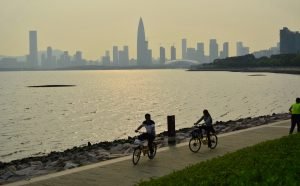

SCMP: When people picture Hong Kong, they often imagine a relentless concrete jungle – a vertical city where glass and steel dominate the skyline. Yet a quiet revolution is beginning to reshape how our city develops.
Last week, the Civil Engineering and Development Department and Agriculture, Fisheries and Conservation Department jointly launched the Hong Kong Nature-based Solutions Design Guidelines. This landmark document signals a shift in how we think about infrastructure and urban planning. It shows Hong Kong no longer needs to choose between development and ecological conservation. Instead, we can design cities where nature and infrastructure work together – strengthening resilience, enhancing biodiversity and improving our quality of life.
The government deliberately chose Long Valley Nature Park to unveil these guidelines. Nestled within the Northern Metropolis, this freshwater wetland offers a powerful example of a nature-based solution in action. It shows how Hong Kong can expand its city while restoring and protecting the natural environment.
The presence of Charles Karangwa, global head of the Nature-based Solutions Centre at the International Union for Conservation of Nature (IUCN), underscored an important message: with the right ambition and collaboration, Hong Kong has the potential to become an international leader in integrating nature into urban development.
The new guidelines adapt the IUCN’s global framework to Hong Kong’s uniquely dense urban environment. They establish three core principles: enhancing biodiversity across ecological structures and scales; fostering a harmonious coexistence between people and nature; and strengthening climate and ecological resilience alongside social and economic sustainability. The guidelines also introduce an evaluation framework that measures five forms of natural capital, supported by digital monitoring tools to ensure nature-based initiatives deliver measurable and scientifically robust outcomes.
The guidelines carry strategic implications for Hong Kong’s future competitiveness. First, it offers a pragmatic way to ease the tension between urban expansion and natural habitats.
Traditional “grey infrastructure” often treats nature as an obstacle to overcome. By contrast, nature-based solutions treat nature as a partner. By integrating blue-green infrastructure into our dense urban landscape, Hong Kong can significantly enhance the liveability of the city. With comfortable microclimates, thriving biodiversity and stronger climate resilience, a healthy urban environment naturally attracts global talent and investment.
Second, the guidelines translate Hong Kong’s engineering expertise into a globally relevant framework. Over decades, the city has developed world-class experience in managing extreme weather and greening high-density environments. The new guidelines package this experience within the internationally recognised language of nature-based solutions.
This shared framework allows Hong Kong’s planning, engineering and design sectors to share their expertise with rapidly urbanising regions such as the Greater Bay Area, Southeast Asia and the Middle East. In doing so, Hong Kong can position itself as a hub for innovation in high-density, nature-positive urban development.
Third, the guidelines help break down entrenched policy silos. Historically, development and conservation have often been treated as a zero-sum game. By collaborating on these guidelines, development and environmental authorities show that nature-based solutions can serve as a shared framework for policymaking. This systems approach helps align Northern Metropolis development, climate adaptation, biodiversity strategies and public health initiatives under a more integrated vision for the city.
Publishing a guidebook, however, is only the first step. Turning these ideas into long-term urban competitiveness will require action on several fronts.
First, Hong Kong must win the confidence of private developers. Biodiversity considerations have sometimes been viewed as regulatory hurdles that increase costs and project risks. This narrative needs to change. Nature-based solutions should be recognised as a development advantage.
Integrating nature into projects can improve microclimates, enhance property values, strengthen brand reputation and prepare companies for emerging frameworks such as the Taskforce on Nature-related Financial Disclosures. It can also unlock opportunities in green and nature-related finance. Hong Kong should explore pilot projects that show how nature-based solutions can attract investment and reinforce the city’s role as an international green finance centre.
Second, Hong Kong must scale up its ambitions. The city cannot rely on isolated demonstration projects. From individual sites to connected corridors and wider ecological networks, nature must be integrated across the urban landscape. The biodiversity richness of areas such as Long Valley Nature Park could extend into surrounding neighbourhoods through networks of urban mini-forests, revitalised river corridors and other forms of green infrastructure. By bringing nature closer to people’s daily lives, Hong Kong can enhance urban resilience while building stronger evidence on the benefits of nature-based solutions.
Finally, Hong Kong should consider establishing a nature-based solutions hub. To ensure these practices take root, a neutral platform is needed to support coordination, collaboration and capacity building. Working with international organisations such as the IUCN, a multi-stakeholder platform could support nature-based solutions implementation in major projects, including those in the Northern Metropolis.
It could also advance research, explore nature-finance mechanisms and train the next generation of urban professionals across planning, engineering and environmental disciplines. Through such a platform, Hong Kong could display how nature can be successfully integrated into one of the most densely built cities on Earth.
Building a city integrated with nature takes time, patience and cross-sector collaboration. The new guidelines provide an important blueprint for the transformation already beginning to reshape Hong Kong’s concrete jungle.
Now, we must build on this momentum. Together, we can turn this quiet revolution into a defining chapter of Hong Kong’s urban future, and a global role model of how modern metropolises can truly live in harmony with nature.
Originally published on SCMP on 15 Mar 2026. Written by Kitty Tam and Calvin Au.